

How To Install Neo4j In Ubuntu 16.04

Introduction
In this tutorial, nosotros will examine what Neo4j is, what it is used for, and how it is implemented. We will also install and configure the installation on an Ubuntu 20.04 server. Neo4j is a graphical database used to create information relationships. Other examples of graphical databases include:
- ArangoDB
- Grakn Core
- Microsoft SQL Server 2022
- OrientDB
- RedisGraph
What is Neo4j
Neo4j connects data as information technology is stored, allowing us to run queries that we never knew or idea about earlier. To put information technology merely, Neo4j records the relationship between data nodes, whereas conventional relational databases utilize columns and rows to store structured information. Since each node stores references to all the other nodes to which it is connected, Neo4j tin encode and query complex relationships with minimal overhead.
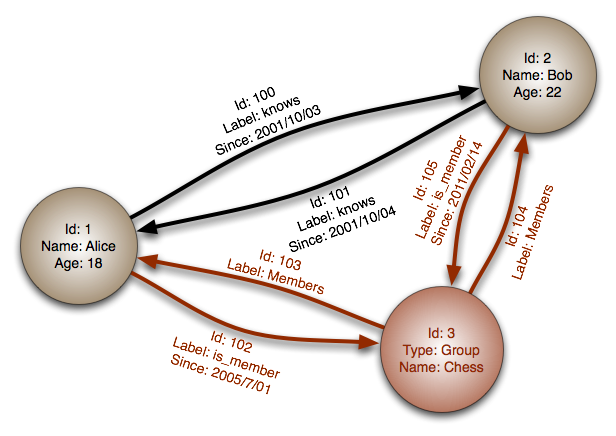
Past Originally uploaded by Ahzf (Transferred by Obersachse) - Originally uploaded on en.wikipedia, CC0, https://commons.wikimedia.org/w/index.php?curid=19279472
Neo Technology is the creator and developer of the open-source software Neo4j. The visitor has been developing information technology since 2003. It is written in Java and Scala, and the source code is freely available on GitHub. As of 2022, it is considered the most utilized graphical database management arrangement in apply today. Neo4j employs its own query language called Null, but queries can as well be written in other styles, for example, through the Java API.
Prerequisites
For this installation, the software requires the following baseline settings.
- 8 GB RAM and a four-core server. At a minimum, the recommended use is 1 GB RAM and a unmarried-cadre server.
- Ubuntu xx.04 OS
- All commands are run as root. If y'all are a regular user, commands must be prefaced by the sudo command.
Neo4j installation
Add Repository
Ubuntu does not officially incorporate Neo4j in the standard package repository. We will add together the parcel source pointing to the location of the Neo4j repository, and so add the GPG key from Neo4j for verification, then install Neo4j itself.
We start by updating the listing of packages and the packages themselves.
root@host:~# apt update && apt -y upgrade
Add Additional Software
In this step, we will install an additional package that is needed for HTTPS connections. This application may be already installed by default on the system, but they still demand to be updated.
root@host:~# apt install apt-transport-https ca-certificates gyre software-properties-common -y The apt-ship-https package enables the usage of https via the bundle manager using the libapt-pkg library. This keeps the installation secure.
Verify Security Key
Now we add together the official security fundamental for the Neo4j package repository. This cardinal check and verifies what you are installing is from the official repository.
root@host:~# roll -fsSL https://debian.neo4j.com/neotechnology.gpg.key | apt-key add - OK root@host:~#
Add Repository
Add the official Neo4j repository to the packet manager list.
root@host:~# add-apt-repository "deb https://debian.neo4j.com stable 4.1"
Install Neo4j
When installing Neo4j and all its dependencies, it is essential to note that the installation will prompt united states of america to install Java packages to piece of work with Neo4j. During installation, press Y. to have this software install. If you lot have Java installed, the installer will sympathise and skip this step.
root@host:~# apt install neo4j -y Reading package lists... Done Building dependency tree Reading country information... Done The following package was automatically installed and is no longer required: libfprint-2-tod1 Employ 'sudo apt autoremove' to remove it. The following additional packages will be installed: cypher-shell The following NEW packages will be installed: cypher-trounce neo4j 0 upgraded, 2 newly installed, 0 to remove and 0 non upgraded. Need to get 116 MB of archives. After this operation, 131 MB of additional disk space volition be used. Become:1 https://debian.neo4j.com stable/four.1 amd64 cypher-shell all 4.one.iii [27,i MB] Go:ii https://debian.neo4j.com stable/4.1 amd64 neo4j all 1:4.i.5 [88,4 MB] Fetched 116 MB in 10s (11,ane MB/southward) Preconfiguring packages ... Selecting previously unselected package cypher-beat out. (Reading database ... 163626 files and directories currently installed.) Preparing to unpack .../cypher-shell_4.1.3_all.deb ... Unpacking zero-beat (4.1.3) ... Selecting previously unselected package neo4j. Preparing to unpack .../neo4j_1%3a4.one.5_all.deb ... Unpacking neo4j (i:4.1.5) ... Setting up cypher-crush (4.1.3) ... Setting up neo4j (1:4.1.five) ... Processing triggers for homo-db (two.ix.1-1) ... Processing triggers for systemd (245.four-4ubuntu3.iii) ... root@host:~#
Showtime the Neo4j Service
Once we have it installed, we need to enable it as a neo4j.service service.
root@host:~# systemctl enable neo4j.service Synchronizing state of neo4j.service with SysV service script with /lib/systemd/systemd-sysv-install. Executing: /lib/systemd/systemd-sysv-install enable neo4j Created symlink /etc/systemd/arrangement/multi-user.target.wants/neo4j.service → /lib/systemd/arrangement/neo4j.service. root@host:~#
Bank check Neo4j Status
Next, we verify that everything is working equally expected.
root@host:~# systemctl status neo4j.service neo4j.service - Neo4j Graph Database Loaded: loaded (/lib/systemd/system/neo4j.service; enabled; vendor preset:> Active: active (running) since Wed 2022-12-23 20:04:44 +03; 2min 4s ago Master PID: 4827 (java) Tasks: 52 (limit: 9489) Memory: 447.9M CGroup: /organization.slice/neo4j.service └─4827 /usr/bin/coffee -cp /var/lib/neo4j/plugins:/etc/neo4j:/usr/sh> сне 23 20:04:46 host neo4j[4827]: 2022-12-23 17:04:46.101+0000 INFO ======== N> сне 23 20:04:47 host neo4j[4827]: 2022-12-23 17:04:47.073+0000 INFO Initializi> сне 23 20:04:47 host neo4j[4827]: 2022-12-23 17:04:47.077+0000 INFO Setting upward> сне 23 20:04:47 host neo4j[4827]: 2022-12-23 17:04:47.077+0000 INFO Creating n> сне 23 20:04:47 host neo4j[4827]: 2022-12-23 17:04:47.083+0000 INFO Setting ve> сне 23 twenty:04:47 host neo4j[4827]: 2022-12-23 17:04:47.085+0000 INFO After init> сне 23 20:04:47 host neo4j[4827]: 2022-12-23 17:04:47.088+0000 INFO Performing> сне 23 20:04:47 host neo4j[4827]: 2022-12-23 17:04:47.197+0000 INFO Commodities enabl> сне 23 twenty:04:47 host neo4j[4827]: 2022-12-23 17:04:47.843+0000 INFO Remote int> сне 23 20:04:47 host neo4j[4827]: 2022-12-23 17:04:47.844+0000 INFO Started. lines ane-xix/19 (END) To go out this screen, press Ctrl + C. It is important to accept the post-obit parameters: Loaded: loaded (/lib/systemd/organization/neo4j.service; enabled; vendor preset:> Active: active (running) since Midweek 2022-12-23 20:04:44 +03; 2min 4s ago
Test DB Connexion
Since we installed Neo4j and started information technology as a service, we will at present test the database connection and configure the admin user.
Note:
Nosotros are using the free, Community Edition Neo4j version. It supports simultaneous work with the same database, but does not include assigning roles and permissions to users.
Working With Neo4j
To collaborate with the database, we volition launch the internal utility called cypher-shell to working with Neo4j. When we commencement run it, nosotros will exist asked to enter a user and password. By default, the username is neo4j, and the countersign is neo4j. After the first login, you volition be prompted to change the countersign to one of your choosing.
oot@host:~# goose egg-shell username: neo4j countersign: ***** Password alter required new password: ******** Continued to Neo4j 4.1.0 at neo4j://localhost:7687 every bit user neo4j. Type :assist for a listing of available commands or :exit to go out the shell. Annotation that Goose egg queries must terminate with a semicolon. neo4j@neo4j> To exit, use the exit command.
neo4j@neo4j> get out Good day! root@host:~#
Add Nodes
Let's set up some sample nodes and define relationships between them. Connect using Zilch
root@host:~# zip-shell username: neo4j password: ******** Connected to Neo4j 4.ane.0 at neo4j://localhost:7687 equally user neo4j. Type :aid for a list of bachelor commands or :leave to go out the beat. Annotation that Zip queries must stop with a semicolon. neo4j@neo4j> Next, let's add a node called Liquidweb and the names of colleagues who work for this company under the name Margaret. Nosotros can practise this using the CREATE command, and the syntax volition be as follows.
neo4j@neo4j> CREATE (:Liquidweb {name: 'Margaret'}); 0 rows bachelor afterwards 36 ms, consumed after another 0 ms Added 1 nodes, Set i properties, Added 1 labels neo4j@neo4j>
Add together Users
Allow's add a few more colleagues and link them to the company they work for, Liquidweb. We will connect using the FRIEND command.
neo4j@neo4j> CREATE (:Liquidweb {name: 'John'})-[:FRIEND]-> (:Liquidweb {proper noun: 'Peter'})-[:FRIEND]-> (:Liquidweb {name: 'Chris'}); 0 rows bachelor after 38 ms, consumed after another 0 ms Added three nodes, Created 2 relationships, Set 3 properties, Added iii labels neo4j@neo4j>
Create Relationships
Since Peter and Chris work in the same department and have the same backdrop as nodes, we will create a human relationship with the name column.
neo4j@neo4j> Lucifer (a:Liquidweb),(b:Liquidweb) WHERE a.proper name = 'Peter' AND b.name = 'Chris' CREATE (a)-[r:DEPARTMENT { name: 'Developers' }]->(b) Render type(r), r.proper noun; +------------------------+ | type(r) | r.name | +------------------------+ | "Department" | "Developers" | +------------------------+ 1 row available afterwards 105 ms, consumed later on another 10 ms Created 1 relationships, Set 1 properties neo4j@neo4j> - Lucifer - This indicates the correspondence of the nodes. In this case, within one visitor Liquidweb
- WHERE - between values
- CREATE - create and add
- RETURN - Return to the base.
Now create a connectedness between John and Chris, although they are in different departments, but they are working on the same projection.neo4j@neo4j> MATCH (a:Liquidweb),(b:Liquidweb)
WHERE a.name = 'John' AND b.proper noun = 'Chris' CREATE (a)-[r:Projection { name: 'Cool Project' }]->(b) RETURN blazon(r), r.name; +----------------------------+ | type(r) | r.name | +----------------------------+ | "PROJECT" | "Cool Projection" | +----------------------------+ 1 row bachelor after 48 ms, consumed afterwards some other five ms Created 1 relationships, Set 1 backdrop neo4j@neo4j>
Display Info
At present nosotros will display all this data and their relationships using the following query.
neo4j@neo4j> Friction match (n)-[r]->(1000) Return n,r,k; +--------------------------------------------------------------------------------------------------+ | northward | r | yard | +--------------------------------------------------------------------------------------------------+ | (:Liquidweb {name: "John"}) | [:FRIEND] | (:Liquidweb {proper name: "Peter"}) | | (:Liquidweb {proper noun: "John"}) | [:PROJECT {proper name: "Absurd Projection"}] | (:Liquidweb {proper name: "Chris"}) | | (:Liquidweb {name: "Peter"}) | [:DEPARTMENT {name: "Developers"}] | (:Liquidweb {name: "Chris"}) | | (:Liquidweb {name: "Peter"}) | [:FRIEND] | (:Liquidweb {proper name: "Chris"}) | +--------------------------------------------------------------------------------------------------+ four rows bachelor after 17 ms, consumed after another 2 ms neo4j@neo4j> We received the output information with the post-obit FRIEND relationships, which evidence the relationship and the following data relationships betwixt DEPARTMENT and PROJECT.
To exit the nothing shell, run the leave control.
neo4j@neo4j> :leave Adieu! root@host:~#
Set up a Secure Remote Connection to Neo4j
Nosotros will not always be able to connect to the database from the server itself. If we want to configure the application to use Neo4j, we will need to configure it to securely connect to other servers. Too, we should configure the firewall in order to restrict which servers can attach to Neo4j.
Past default, Neo4j connects via localhost (127.0.0.1 - localhost - intended for testing applications without working with other servers). As well, the work of Neo4j from localhost volition not be open for public access to the Net. Merely users with access to the local network will be able to connect to Neo4j.
Configure Neo4j
For Neo4j to connect to other servers, we demand to change the settings of the configuration file /etc/neo4j/neo4j.conf. We will use the nano editor for this task. Call back, if you lot are not root, employ the sudo command.
root@host:~# nano /etc/neo4j/neo4j.conf root@host:~# Detect the line in the Network connector section
#dbms.default_listen_address=0.0.0.0 Uncomment this line past removing the # symbol and then press Ctrl + S and Ctrl + X to salvage and go out the editor.
The 0.0.0.0 value will bind Neo4j to all available IPv4 network interfaces. You can put a specific IP accost or network that your servers use as a data path. You lot can likewise configure it to use IPv6 interfaces, simply in that location are many nuances to that setting. Nosotros recommend that yous read the documentation on the official website.
Configure Firewall for Remote Connections
To configure the Neo4j software for remote connections, we must configure the firewall. Nosotros restrict access so that only trusted systems can connect to information technology. In this case, we volition employ the default Ubuntu firewall, UFW.
Side by side, nosotros must bank check to see if the firewall is activated. If it is not active, we have to enable it.
root@host:~# ufw enable Firewall is active and enabled on organisation startup root@host:~# Neo4j creates 2 network sockets when installing the software. One on port 7474 for the HTTP interface and the one for the primary protocol on port 7687. Neo4j recommends using port 7687. The command to open a port will be like to the following command used for allowing an IPv4 address.
ufw let from YOUR_IP to any port 7687 proto tcp YOUR_IP - Apply an IP here to provide access permission. If you lot want to allow access to the unabridged local network, utilize the following rule: ufw permit from 192.168.l.0/16 to any port 7687 proto tcp Enter your specific network range to open up the port. For an IPv6 address, the command will wait like this.
ufw allow from fe80::1006:f7a3:b9cc:b0cb to any port 7687 proto tcp The above IPs are used equally an example. Substitute your values and add a rule.
root@host:~# ufw allow from 192.168.l.189 to any port 7687 proto tcp Rule added root@host:~#
Restart Firewall
Be sure to restart your firewall.
root@host:~# ufw reload Firewall reloaded root@host:~#
Verify Connection
Now permit's bank check to see if it is working correctly.
root@host:~# ufw status Status: active To Activeness From -- ------ ---- 7687/tcp ALLOW 192.168.fifty.189 root@host:~# And with that, we have a working Neo4j server that's set up to go and configured to allow access on port 7687.
Conclusion
We met with the Neo4j graphical database, learned how it works and why it is needed. Set a bundle director and then installed Neo4j. Next, we checked the functionality, went into it, and changed the password. We tried basic commands on how to create a tabular array, brand relationships, and ready nodes. In the end, nosotros configured the connexion to the IPs we needed and configured a firewall for security.

Source: https://www.liquidweb.com/kb/how-to-install-neo4j-on-ubuntu-20-04/
Posted by: reeddonsagovive99.blogspot.com
0 Response to "How To Install Neo4j In Ubuntu 16.04"
Post a Comment